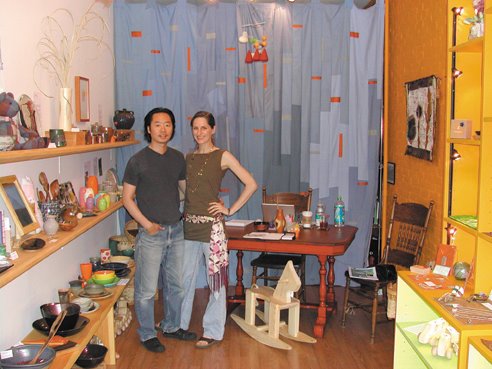
(This is the second in a series of draft essays on exploring the history of craft and the place of craft in the U.S. today. Click here to read the first. Feedback is welcome!)In the years before Jae and I opened Greenjeans, we worked in the art world in galleries, museums, and art handling companies. Part of the appeal of opening a shop devoted to fine craft was that we'd be getting out of the art world and entering into what we thought to be the much more down-to-earth, plain-spoken, and generally friendly craft world. And by and large, that's how we've found the craft community to be.
What we didn't expect was to find a
heated debate here about the terms "art," "craft," and "design," and whom they apply to. The debate, played out in craft magazines, craft forum message boards, speeches at craft fairs, and conversations with members of the craft community, encompasses questions about whether or not craft is art, whether design is craft, whether craftspeople are artisans or artists or designer-makers, and so on.
As much as this is an academic debate, it is also importantly an economics debate, driven by the craft world’s pursuit of a greater market share for aesthetic functional objects and sculpture. Representing the most extreme of desperate measures, there has even been a move in recent years to do away with the word "craft," as it's seen by some as "unmarketable."
It is notable, however, that the craft world seems more concerned about these delineations than the art or design worlds. I never once came across this debate during my tenures in art galleries and museums. The seemingly one-sidedness of this debate is likely due to the art and design worlds already holding down well-established markets that the craft world wants access to.
Many in the craft world go on the defensive in this debate, arguing that their work is just as good if not better than other items in the marketplace and should be given more attention. A blame-game often ensues, criticizing craft organizations for not drawing enough new buyers to their shows, or home and design magazines for not paying enough attention to artisan-made work. On the art side, some craft artisans complain of not receiving serious attention by art galleries and museums, much less the same high prices collectors will pay for art.
From my point of view, taking a defensive position in this debate is not raising the craft world to the kind of level it craves. What is needed for the craft world to really find its way is a new attitude. Rather than vie with the art and design worlds for entree into their exclusive clubs, why not focus attention on raising awareness about the option of craft for satisfying the consumer's aesthetic sweet tooth? If we can shift the image of craft as something open, fun, accessible, sexy, and desirable – all of which it is – the craft world economy would benefit enormously, and with it its stature in the cultural matrix.
At the same time, a more holistic and certainly more refreshing approach to the debate is to find fluidity among the categories of craft, art, and design. There will never be a consensus on how the lines should be drawn, so wouldn't we be better served to allow those lines a permeability and flexibility? Can't an object be art and craft and design all at the same time? (Aren't all objects all three to some extent, even if by virtue of their lack in one of these categories?) Then why all this debate about claiming an artist or an object for one camp only?
I propose a loosening of the grip on these three words: art, design, and craft. At the same time, I propose that we reclaim the word "craft" for the craft world, and stop trying to call it art and/or design. This isn't to say we should draw a circle around everything "craft" and claim it with, well, defensiveness. On the contrary. We should call craft "craft" if that's what we consider it to be and stop trying to be all politically correct about it.
To this point, I will register with no hesitation my firm disapproval of the former American Craft Museum in New York changing its name to the
Museum of Art and Design. Expunging the word "craft" (perhaps because it failed to entice marketing focus groups) and replacing it with the trendier words "art" and "design" does a great disservice to the craft world, even as the museum itself seeks to broaden the parameters of what constitutes craft. It is too bad that as a brand name, "craft" is lacking in sex appeal, but the museum's new name is utterly meaningless by comparison.
It amazes me how many artisans deplore that very moniker, insisting instead on being referred to as an artist or a designer, or at least a craft artist. The word "artisan" is anathema to so many of them. Yet I find it to be the
mot juste, bearing an intriguing yet professional connotation. It is alluring and serious at the same time. Personal. Creative. Careful. The word “craft” carries the same connotations.
I have read that one of the primary reasons for the aversion to the world craft is its associations with labor. “Artisan” has an earthier aspect than “artist,” and certainly than “designer.” A designer doesn't break a sweat; a craftsman or artisan definitely does. (Well, maybe not literally, but effort-ful work is always a factor.)
What'swrong with sweat? Sweat is honesty. Sweat is real. Sweat is life and earth and work. Sweat is the exertion of our humanity.
Claim your sweat! Call yourself an artisan! Call your work craft! Say it with confidence and pride! Let's unite as the craft world, empowered and focused and real.
Let’s focus on building and marketing a strong, appealing, relevant craft world and leave the other worlds be.

















 Posts
Posts


