Saturday, June 24, 2006

At Last, The Display Cases!


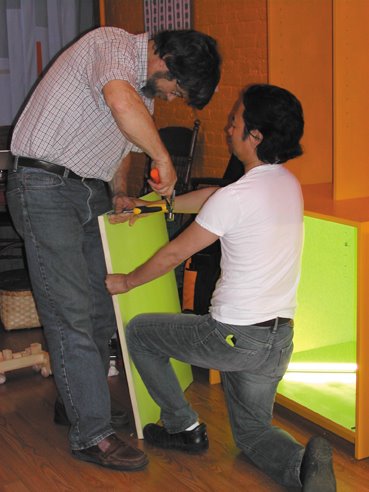
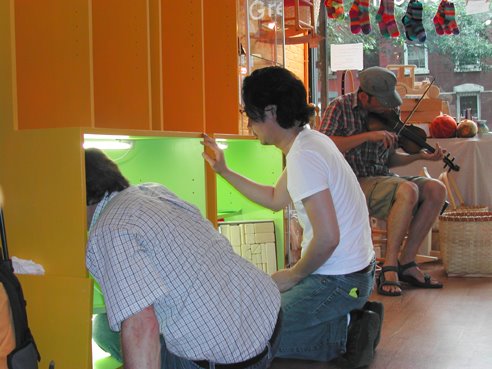
Yesterday my Dad (Dick Shaw) and Jae installed the display cases that Jae and I designed and Dad built. They're made from 18" wide pine board planed by a guy in Deerfield, NH, tons of bumble bee yellow and pear green paint, and a whole lot of love. Next week we'll install halogen lights to brighten the cases and make things really pop!

This means that the beloved French door we'd found on the street and had been using to display things on is no longer living here at Greenjeans. It has moved on to grace the apartment of our friends Regan and Anders. We'll miss it, but not the sawhorses that held it up for so very long!

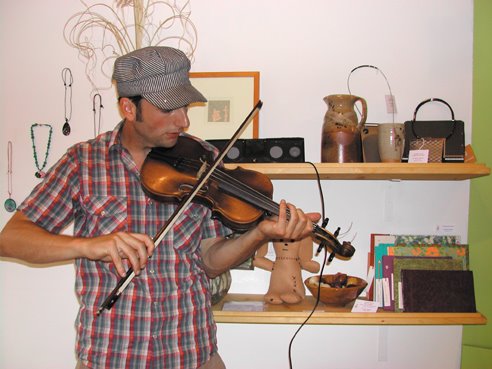
Also yesterday, Old Time Dave Talmage, an up-and-coming fiddle player who came down with my Dad from NH to see his girlfriend play a gig at the Living Room, gave us a wonderful in-store concert as Dad and Jae worked. I can't imagine a better situation -- new display cases, live bluegrass music, and love all around us! Here are some pictures, and come on by to check out the cases!


Wednesday, June 21, 2006

Review: The Renegade Craft Fair

On Saturday, June 17, my friend Steph and I ventured to McCarren Park in Williamsburg, Brooklyn, for the 2nd convening of the Renegade Craft Fair.

Billed as “a unique DIY [Do-It-Yourself] event,” the fair offered nearly 200 booths of work made by an enthusiastic group of mostly younger (20-35) artists and crafters at a broad range of commercial and artistic development. It was started in 2003 by Sue Blatt and Kathleen Habbley, two women from Chicago who had taken “up crafts as a hobby after college and decided to try selling our stuff in local fairs. To our surprise, no events were catering to the burgeoning DIY craft community or even prohibited crafts all together. So we thought of organizing a fair of our own that tapped into this movement and provided a laid back, fresh venue for artists and shoppers alike.”

What We Saw

Most of the work for sale was image printed (tee-shirts, bags, baby onesies, note cards, buttons, magnets) or sewn (handbags, skirts, tee-shirts with felt appliqué). Bookbinding made a strong showing, as did jewelry. There were only a couple soap-makers (many fewer than I expected), two ceramicists, and a smattering of knitters, spinners, and stuffed doll makers. Steph noticed that everything seemed fairly portable as befits the needs of the urban consumer, and probably that’s why there wasn’t a lot of furniture or sculpture.

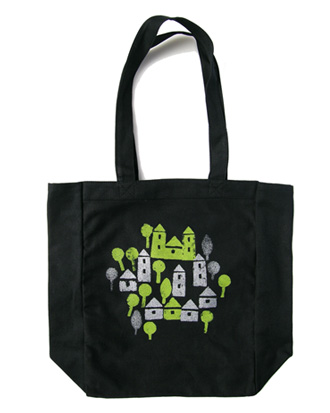
We were somewhat confused and disgruntled by how some booths were crammed with shoppers and some were empty, and it seemed to have much less to do with the quality or originality of the work than with how many publicity mentions from Lucky magazine and Daily Candy were stuck to the pole holding up the canopy. Yet we agreed that there was very little junk and we both saw lots of items we liked. Nothing was expensive, though I made the mistake of bringing only $30 in cash, limiting my take to a few Brooklyn-made note cards by Foxy & Winston (shown at bottom) and an instant-favorite tee shirt by Maryink sporting the designer’s take on the fair logo.

While the sunny faces, palpable community spirit, and outdoor invigoration felt very craft-fair-like, content-wise the Renegade Craft Fair bore little resemblance to the New Hampshire fairs of my youth in the ‘70s and early ‘80s. In place of potters, basket weavers, furniture makers, and bluegrass musicians there were hipster tee-shirt-, handbag-, and note card-designers, funky jewelry makers, and a motley group of bombastic “revolutionary cheer leaders.”

Yet as much as the Fair seemed like a ‘70’s country craft fair turned on its head, the predominant aesthetic trend represented there seems to draw directly from that era. Many of the work seemed to draw from a Partridge Family look and palette. Think Cat Stevens album covers and avocado-and-mustard colored living room schemes, then translate that into a tote bag (like the one by Maryink shown above), and you get close to the idea. It’s an appealing mix of nostalgia and postmodern clambake for the under-40 set who grew up with that aesthetic. As Steph writes, “It's interesting to see how things settle in the subconscious of an entire age group only to be expressed years later in slightly different form.” Indeed.

What We Thought

The overall sociological sensibility seemed to relate to the 70s as well. Steph observed that among the crafters there “seemed to be a lot of third-wave feminists,” and definitely not many “hippie-crunchy folks.” I’d call them instead “hipster hippies.” Peering into the fair’s demographic, Steph writes, “DIY is an interesting phenomenon for feminists to latch onto. It's a great way to express creativity but there's also such a strong anti-consumerism (mainstream consumerism, that is) ethos to it. They take traditional ideas, materials, methods, but then put a sort of rebellious spin on them. It's an interesting juxtaposition. And a statement about the mall-ification, mass-produced nature of our society.” To some extent I think that’s what craft has been about since the Industrial Revolution and the rise of the American and European Arts & Crafts movements (see previous posting on this topic). It’s pleasing to see the next generation in action.

This issue of where craft ends and design begins came up in my mind about halfway through the fair. Feeling like I couldn’t look at another clever appliqué-over-silhouette design, I turned to Steph and asked, “is screen printing a tee-shirt really craft?” At the American Craft Council fair, unless the artisan wove the cotton jersey and stitched the seams themselves (and I’ve seen nothing of the sort), you will not find a single printed tee shirt. But at the Renegade Craft Fair, unless it’s an abandoned chair someone found on the sidewalk then covered in pages from vintage magazines, you won’t find a single stick of furniture. Is “craft” big enough to accommodate both extremes?

Later that day, Rena from Rare Device stopped by to compare notes – she’d been at the fair as well. She put her finger on the button when she mentioned another craft fair in Seattle recently going “more indie.” That was it – indie! That was the word Steph and I had been searching for.

Craft is a large, flexible word. It is the umbrella concept under which you will find everything from indie to fine. I’d venture that at a certain point of technical proficiency and clarity of expression a crafter becomes an artisan. But other than that, craft is for everyone who makes it. If you’re not sure about that, then next year treat yourself to the Renegade Craft Fair and decide for yourself!

Highlights from the 2006 Renegade Craft Fair
(Some of these may be appearing one day at Greenjeans...)

:: Jeweler Kurt Van Maarth’s sturdy display case made from cardboard, duct tape, and plexiglass. His work – especially the skull belt buckle – is a highlight too.

:: Sew Betsy Ross’ packaged dress and skirt patterns--just like Mom used to get at JoAnn Fabrics, but hip

:: Jessica Rosenkranz’ beautifully bound small edition books (charming tiny storybook about a chicken).

:: Prints and note cards by Julie Meredith (girls on swings, riding bikes)

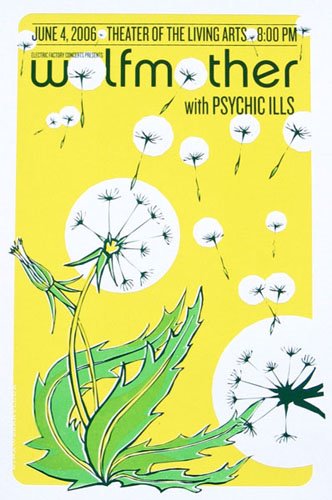
:: Strawberry Luna’s fabulous rock posters (Iron & Wine, Belle & Sebastian) - see above

:: Mat Daly’s woodblock posters for Renegade Craft Fairs past and present

:: Necklaces and rings made from silver casts of twigs and birch bark by Twigs & Heather

:: Scott Urban's custom wooden eyeglass frames

Friday, June 16, 2006

New Arrivals from Davistudio / Toward a Phenomenology of the Handmade

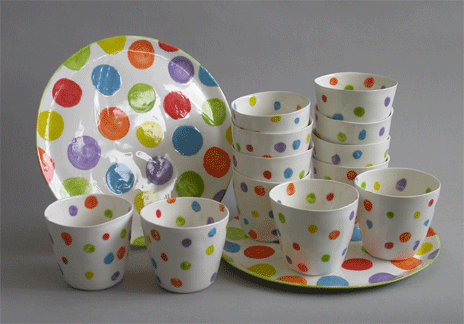
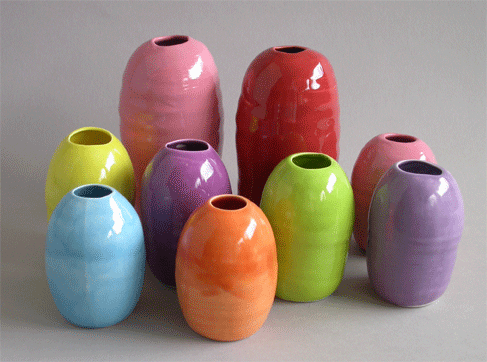
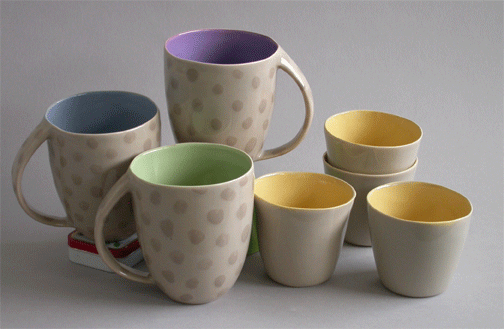
We received two big boxes of work from Mary Anne Davis (Davistudio) yesterday! Mary Anne took these pictures for her wonderful kiln-opening blog, and I've borrowed them to show you here. Most of the fabulous pieces shown are now available at Greenjeans -- come in and check 'em out!

* * *

Toward a Phenomenology of the Handmade

In grad school, I studied Heideggerian (or existential) phenomenology with Tom de Zengotita. I wrote about “barnness” for my thesis, trying to understand philosophically why people care to save old barns in NH. Since opening Greenjeans, I’ve wanted to explore a phenomenology of the handmade. This interest relates to my curiosity about the overlapping realms of art, craft, and design, which I began exploring in this earlier blog entry. Today the investigation continues…


It's always exciting to open boxes of new work, but often times it's really a very special experience because each and every piece is possessed of a very unique liveliness. This may sound overblown (especially since pictures gloss the work's tacticity), but if you've ever handled something skillfully handmade before you'll have an idea of what I'm talking about.
Mary Anne Davis' work is vividly imbued with this quality. When I unwrap a piece of her pottery it's like meeting a new person or seeing a new species of plant up close for the first time. I might know that what will be inside a curl of bubblewrap is a blue seed vase, but once that veil is removed the object shows me its particular interpretation of what it is to be a seed vase, revealing itself as the individual being that it is. This is part of what makes handmade work so incredibly different from machine-made items.

What do I mean by this? Well, like people, each of Mary Anne's pieces has its own particular quirks and characteristics. Some are perfectly formed and evenly glazed and unblemished. But those are the minority. Most pieces have a little something about them that makes them unique and lively: maybe the glaze runs thin along one side of a vase, maybe the mouth of an udon bowl is slightly oblong causing it to nest askew (though not uncomfortably) when stacked, maybe there are a few white pinpoints down the side of a juice cup where some air bubbles escaped. These are birthmarks that needn't be considered errors; on the contrary, they speak to the snowflake pattern of the soul. Mary Anne makes space for them, allowing each work to be its imperfect self, in keeping with the Japanese philosophy of wabi-sabi. If a crack emerges during firing, or a handle sits too low making a mug dangerously unstable, the fish gets thrown back in the pond since these traits impair the physical integrity and usefulness of the work and do not just automatically get covered by the philosophy of beauty-in-imperfection. But most of the time what emerges from the kiln is sound and saleable.

In the same way as when we deal with people, when we use these dishes we accommodate their unique set of quirks in order to have a good relationship with them. And in fact it is these quirks that make the dishes, like people, intriguing, different, beautiful, and even loveable. It is no wonder that Mary Anne is also involved in peace activism.

Mary Anne's pottery is more than just functional craft. It also enters the realm of art by the way each work negotiates the line between imperfection and defection (as described above), and by the way each work engages our curiosity and care. Speaking to this second point, when I handle her dishes at the shop or the ones I live with at home, I am always distinctly aware of them. They are never just objects, they are always calling my attention to them with the special way they feel, their colors and patterns, and their unique birthmarks. I know they are fragile (though not as eggshell-fragile as they may seem), and so I handle them carefully. I enjoy how the work invites this mindfulness, and am often amazed at how spiritual a little porcelain bowl or cup can be.

The machine-made dishes I also use at home, no matter how well designed, certainly do not effect me this way…

Saturday, June 10, 2006

Dispatches from Japan


Yesterday we received an exciting package from Japan: the new issue of Baby Life, a very beautifully produced lifestyle magazine for Japanese parents, with Greenjeans featured on page 9! (Also enclosed were some beautiful little paper ornaments with origami geisha and flowering trees on them -- amazing!) The Baby Life piece is by a woman named Yuri Numata who happened into the shop several weeks ago and fell in love with the handmade toys by Frank Ridley, turned wood rattles by Tom Dubois, and the silver spoons by Tamar Kern that we have here. Turns out she was working on a piece about kid-oriented shops in NYC, and she asked if she could feature us! I have no idea what the article actually says, (I hung it in the window anyway), but we are very excited for our first international exposure. Thank you, Yuri!!

Speaking of Japan, I read a piece in New York Magazine this week about something called the Peace Boat. For around $11,000 you can book passage for a three-month cruise during which you'll attend lectures and seminars on peace-related topics, visit countries ravaged by war and poverty in order to lend a hand rebuilding, and meet like-minded people for fun, education, and romance. It sounds like a great way for Japanese college kids and 20-somethings to spend their summer (and a serious wad of cash). There is talk of starting an American version, too. Says the cruise organizer, “We want to become successful in the cruise industry as well as the peace industry." The peace industry? Is that really happening? (See my earlier post about Branding Peace for more on this concept.) Hmmm.

Also from Japan, today I happened upon this frankly inspiring website for an organization called Japan for Sustainability. They write:

"After the Kyoto Conference on climate change in 1997, activities to address global environmental problems gained momentum in Japan and expanded across many sectors. Today one can see many initiatives by the central and local governments, industry, research institutes, universities, non-governmental organizations and individual citizens. We feel that every country has something positive to contribute, and that people in other parts of the world may find useful ideas from Japan, in some of its advanced technologies, systems and partnerships, approaches to information disclosure, and other developments.

"There may also be lessons from the past before the modern day Japan had a tradition of sustainability. The Edo Period, lasting about 300 years, from the early 17th to late 19th century, appears from today's perspective to have been one model of a sustainable society. During that period Japan was self-sufficient in food and energy, had low population growth and recycled almost all materials. One may find clues for a new type of sustainability in the wisdom, craftsmanship and lifestyles of the past."

That last sentence nails it as far as we're concerned.

In unrelated news, tonight we're going out for dinner with our good friend Amy at The Grocery, a Smith Street institution that somehow we've never been to. My mouth is already watering for farmer's market fresh ingredients and a nice bottle of wine...

Until later, arigato gozaimasu!


Friday, June 09, 2006

Loads of New Arrivals!


This week we received new work by, count 'em, NINE artisans, four of whom are brand new to Greenjeans!


Work by New Artisans:
(Look for introductions to these new artisans soon...)

:: Felted wool bowls, boxes, and balls (you gotta see these!) made in Ohio by Feltworks
:: Hardwood cutting and serving boards made in Pennsylvania by Buff Brown
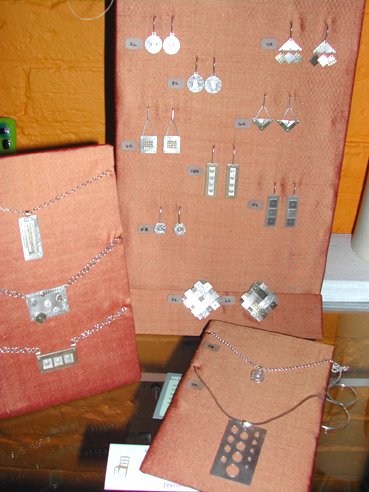
:: Fresh silver art jewelry made in Boston by Melle Finelli (shown above)
:: Precious, mysterious ceramic jars made in San Francisco by Barbara Sebastian


New Work by Favorite Artisans:

:: Connie Verrusio - cufflinks (mini gears), earrings (film, mini gyroscopes), and pendants (silver castings of the insides of seashells)
:: Matt Eskuche - more black glass dogs (these are slightly bigger than earlier ones)
:: Wendy Stevens - stainless steel picture frames (up to 4" x 6") and barrettes
:: Kimberly Navratil-Pope - new designs involving plant fiber, silver, bakelite, and Cracker Jack boxes (not necessarily at the same time)
:: Sol Mate Socks - a fresh new batch!!


Recent additions also include work made by Brooklyn-based jeweler Alison Mackey who creates cheerful, wearable jewelry from photographs framed in silver under clear resin (her pendants are especially fabulous); and elegant botanical jewelry made in Madison, WI, by Janice Ho (her craftsmanship is mind-boggling).


It's going to be a gorgeous weekend, so come on by and discover what's new at Greenjeans!

Thursday, June 01, 2006

Poppies!

I am a nut for poppies. Few things send me over the edge like 'em. It's also one of my favorite floral motifs in decorative arts (the Art Nouveau artists did them especially well), and I aspire to amass a big (though picky) collection over my life. I don't think I could ever get enough of them. It's kind of embarrassing, but I can't help myself!

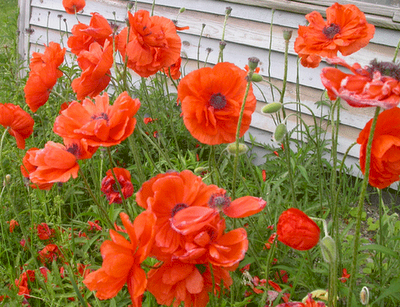
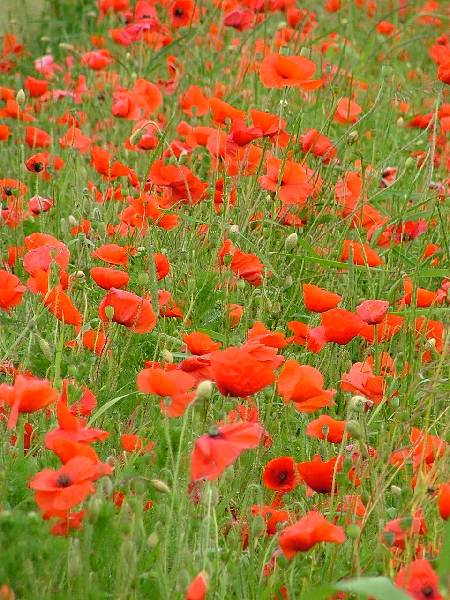
So when potter and blogger Mary Anne Davis posted this picture of the poppies growing around her house in Spencertown, NY, it swept me away! And I just had to share it with you all.

Nothing else today. These gorgeous poppies are more than enough...

[Later]

Well, why not more? I'm actually home taking a day off today (finally!), and I found myself searching for images of poppies on the web after I posted above. Here are some of what I found:

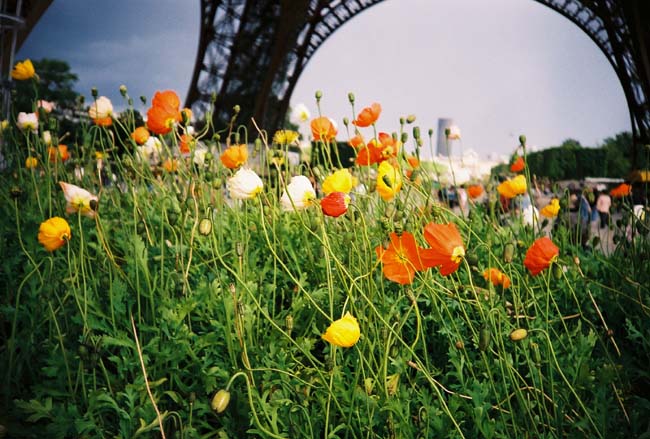
Poppies beneath the Eiffel Tower, found here.

Reminds me of the field of poppies in the Loire Valley of France where the vermillion flowers first stole my heart. These are in Marseille.

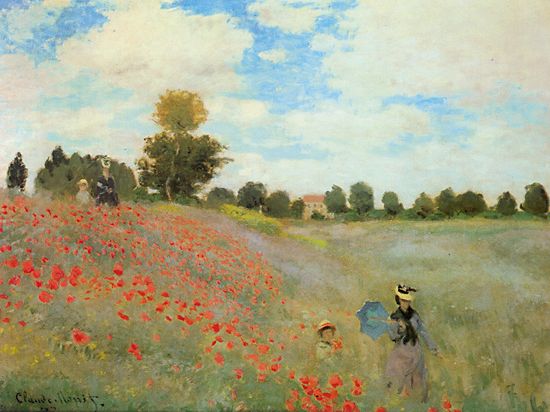
I saw this, Coquelicots à Argenteuil painted by Claude Monet in 1873, at the Musee D'Orsay during my first visit to Paris when I was 17. It sparked instant Impressionism Fever that lingered well into college. (I even had a barrette with a printed image of this glued on it. Oy.) But whatever, who doesn't love this paiting?

In 1996, my Mom and I took a trip to Italy together. We rented a car and drove around Tuscany and Umbria, and saw lots of wild poppies like these growing along the stone bankings along the hill roads. I took some wonderful photographs of them (though this one's from this site). Maybe I'll be inspired to dig out all my poppy photographs and put them together sometime...

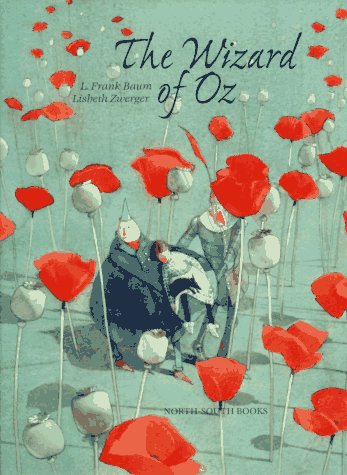
Found this fabulous cover of a volume of The Wizard of Oz illustrated by Lisbeth Zwerger while doing an image search for a still of the poppy field scene from the movie. I wonder if there's a poppy blog out there... If not, I just might start one -- there are fantastic images out there!

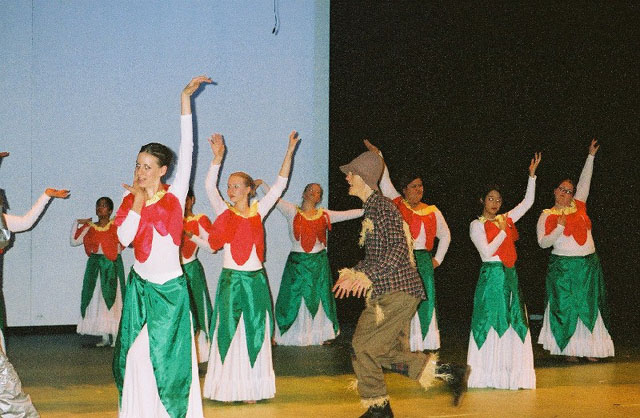
Check out these poppy costumes from a Illinois high school production of the Wizard of Oz! Ok, there's definitely a blog idea here...

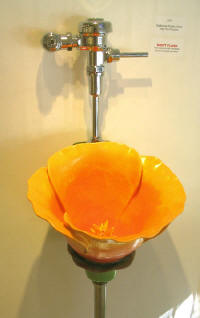
Evidently, there's a guy in California who makes handmade sculptural urinals. Wow. I can't believe it either. Do we need these at Greenjeans? (Click here for his site.) (Though on an aesthetic note, I am not as large a fan of the California poppy. It's nice but it's not the same.)

Thinking so much about poppies reminds me of when I was a kid the old men of the town would go around once a year and sell paper poppies to raise money for the VFW. (Do they still do this? Let's see... It's actually the American Legion... and they're made by disabled veterans. Who knew?) According to Wikipedia, the red poppy has to do with Rememberance Day (est. by King George V in 1919, we call it Memorial Day) where it's a symbol of honor to those who have fallen in war. (Read this haunting poem called "In Flanders Fields.") Huh. Imagine a public display of one poppy for each fallen soldier since 9/11 planted in the middle of the National Mall... Woulda been a good Memorial Day display... (Oh weird, The Stars and Stripes Forever just started playing on WNYC. Freaky!)

But growing in a field they're the best!

Technorati tags:

Tuesday, May 30, 2006

Greenjeans Recommends: An Inconvenient Truth


Two nights ago, Jae and I went to see An Inconvenient Truth, the new documentary about global warming by Al Gore, who evidently has been using his time very well since the 2000 election. The film was surprisingly engaging and definitely eye-opening and we stayed up until 3:30 in the morning talking about it. Jae said it was the best $10.75 he's spent in a long time.

It's worth noting right away that this isn't an anti-Bush film. It isn't Al Gore's attempt to save face after the election. And it isn't Super Size Me or even Fahrenheit 9/11. It is darker and more serious than these. There's nothing blatant about it that should upset conservatives politically speaking. It will, however, spur discussion and hopefully do a lot to raise awareness no matter how you vote.

That said, one of my first thoughts while watching the film was "Wow, the mainstream media really doesn't want us to know about these stories."
That might be the biggest strength of the film: delivering valuable information in a clear, concise way that you probably won't get all in one shot anywhere else. And when given in one shot, the information makes a much bigger impact on your conscience.

The other thing that struck me was how engaging Gore is, and how much looser and more human he seemed compared to when he was running for President. The film consists mostly of Gore presenting the slide lecture on global warming that he's been passionately giving and refining for about 20 years. And he has all of the attributes of an effective professor: he's articulate, he's confident without being cocky, he has a vast understanding of his subject, and he really wants to share his knowledge with you. He's even actually funny sometimes. There are also some biographical moments that contextualize his passion and make him seem much more likeable than I'd thought him to be. I enjoyed the time in Gore's virtual presence and left the film wishing I could spend more time learning from him.

As for the science presented in the film, I found it to be completely convincing, and not at all trumped up like a lesser filmmaker might have done. In a story like this one, there's no need to make things up -- the evidence is already so dramatic and irrefutable. Gore's projections for the future seemed plausible too (albeit fairly horrifying), though that's where critics will take issue. But there's not much to argue with when the science mostly consists of graphs tracking things like the levels of CO2 in the atmosphere or actual temperatures recorded over time. It isn't fuzzy math. It's straight up numbers. Very hard to argue against.

As for the content of the film, there is just too much to say. Nobody has to make a case for whether or not global warming is a real thing, though the film does lay out the science for those of us who were not sure how it all works. So many troubling and heartbreaking examples are given about the effects of global warming, though not in a manipulative way. For instance, because spring is arriving sooner in some areas, caterpillars are hatching earlier and there's nothing for mother birds to feed their young. Cities built thousands of years ago at an elevation above the mosquito line are being infested because with the rise of average temperatures mosquitoes can survive at higher altitudes. And we've all heard about polar bears drowning due to the break up of the ice floes in the Arctic. In addition, the film talks about how so many weather records are being set these days. The ten hottest years on record occurred within the last 14 years with 2005 being the hottest. Last year a region of India received 37 inches of rain in 24 hours. In other areas, rivers and seas that have served the ecosystem and communities for (hundreds of) thousands of years have dried up within the last two decades. If you want more examples, just read the Daily Grist any day of the week -- today's mentions both a severe 18 month drought in England and the negative effects of frequent hurricanes on things like mangrove trees in Florida.

The aim of the film is to put all these pieces together, and when taken as a whole not only does the situation look much more critical, but it also looks more manageable than I'd ever considered it before. For as he points out toward the end, it's not as if we don't know what to do about global warming. We do know what to do and we have all the technology to make a significant difference. It's really a matter of action.

There is so much more evidence, so many other stories and facts we don't hear about, especially things happening in other countries. They are too many to enumerate. And for that reason alone this film is worth seeing. In fact, I can't think of a single reason not to see this film. If you can, see it in the theatre and don't wait for the DVD. The footage of glaciers and arid plains is really spectacular, and the graphs and charts look great all huge. If we could, Jae and I would personally send every single person we know free tickets to go see it and screen it around the clock for a month at Greenjeans. And if and when you do go, bring a kid if you can. Kids will get it and it could make a very positive impact on them.

Watching this film won't save the planet. But it can educate us to more deeply understand the problem and motivate us to take action that will.

Visit www.climatecrisis.net for more information, including theatres screening the film.

Skeptical? Read "Did Al Get the Science Right?" in Salon.com
http://www.salon.com/news/feature/2006/06/10/truths/index_np.html
(click on "free pass" to read entire article if you're not a subscriber)

Other blogs discussing this film:

http://www.two-twelve.net

Friday, May 26, 2006

A Week Away from Greenjeans

Wow, it's been a while since my last posting! Where have I been? Well, this past week has been devoted to family as Jae's brother got married on Sunday and his family from Korea have been in town. Our friend Sarah has been minding the shop since Sunday, and today is my first day back in nearly a week, though it feels like it's been months!

It has been an incredibly eventful week. My sister and Dad stayed with us over last weekend so they could attend the (very large) rehearsal dinner and then the (incredibly lavish) wedding on Sunday. The wedding was splendid -- Sung and Amy had a choir boy sing for the ceremony at Grace Church downtown, and the reception was held in the utterly palatial metropolitan Club on 60th and 5th. (The Club's manager said it was the very first time that an Asian party had ever taken place there!) Everyone had a marvelous time. They are now on their honeymoon in Barcelona and Madrid. And cousin Kyu had to leave the wedding early to catch a flight to Tanzania where he had an assignment for work (he works for a non-profit trying to help end global poverty). So we've missed all of them this week.

In the days that followed the wedding, Jae and I helped entertain his family, taking them to the Met, to SoHo, and of course, to Greenjeans! Jae's cousin Kaewon is interested in branding and graphic design, and so we decided that he should be CEO of Greenjeans in Korea. He's going to start working on our on-line presence there once our website is done. Who knows? Maybe one day we'll have Greenjeans-Seoul!

Jae's family is quite a wonderful group of people, and we always have an incredibly fun time together. Last night, we had an early Memorial Day barbecue. There were about 15 or 20 of us, and Jae did much of the cooking. We ate pounds and pounds of succulent king crabs, steak and hamburgers and hotdogs (all organic of course), piles of fruit and salad, and lots of beer and vodka. After we ate, Jae's uncles and aunts sat around the kitchen table singing old Korean songs while all the cousins watched the great wedding video Jason made of our wedding. It was a wonderful, memorable night.

But it's really nice to be back at Greenjeans today! It has been a slow day, and will likely be a slow weekend what with so many folks away on their first-week-of-summer vacations. And that's fine by me -- we have a lot of work to catch up on here.

Next week I'll blog about some of the new work heading our way. So until then, have a great long weekend!

Thursday, May 18, 2006

Choose: History of Craft or Great Enamel Pendants

Choose-Your-Own-Greenjeans-Adventure!

Today's post offers two options: one's eye candy, the other's brain candy.

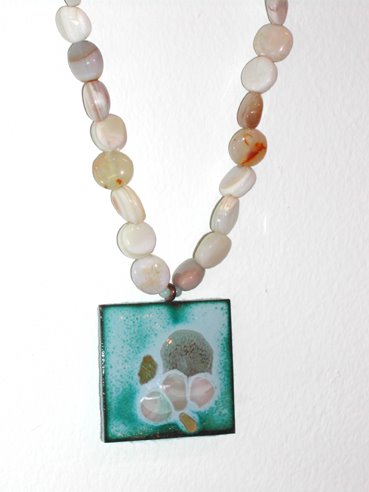
1) View an updated slideshow of enamel pendants (like this one -- so perfect for spring dressing) available at Greenjeans made by Alana Dlubak by linking to this previous post, or

2) Read an essay I wrote exploring the place of craft in today's society and economy.

Enjoy!

Here's the essay:

History of Craft: An Initial Overview
by Amy E. Shaw


I've often wondered why there is such a distinction between the art world and the craft world in our society. Why is fine art so highly revered while fine craft hardly registers on the cultural radar? Why is there a hierarcy placing art above craft, and artists above artisans? Aren't both art and craft equally vital to an expressive culture? Don't they both have value?

As part of my exploration of these questions, I will from time to time post short essays in response to things I'm reading and thinking about. Starting today!

Recently I've been reading a collection of essays titled Objects & Meaning: New Perspectives on Art and Craft. Co-editor and independent curator M. Anna Fariello in her essay "Regarding the History of Objects" lays out a geneaology tracing the development and divergence of art and craft.

Until the Renaissance, art and craft were virtually synonymous. The turning point came with the publication of Giorgio Vasari's classic work The Lives of the Artists, which fostered a lasting sense of "object fetishism, creator worship, and primacy fascination." While painting found a place next to theory and criticism, "the three-dimensional arts became ideologically coupled with manual labor, domesticity, and physicality." The European Salons and art museums emerging in the 18th and 19th centuries institutionalized this division of high art vs. common craft.

The Industrial Revolution of the 19th century spurred a flourishing of craft due to the high-profile dedication of people like John Ruskin and William Morris, founders of the Arts and Crafts Movement in England. "Reacting to a workplace in which labor was fractured into meaningless tasks and to an environment filled with goods of questionable quality, the Arts and Crafts Movement began... as a counterrevolution... It represented a shift toward Eastern aesthetics, a corresponding reverence for simplicity, and an elevation of everyday experience from the physical to the spiritual." She continues, "Critic John Ruskin gave others courage to pursue the idealization of the household object and its private contemplation when he stated, 'Every artist was a craftsman and the simplest household object worthy of his serious effort.' Thus, one might consider English Arts and Crafts to be a privitization of the aesthetic experience."

The craft-conscious Vienna Secession, L'Art Nouveau in France, the German die Jungendstil, and the American Studio Craft Movement emerged at the same time. During this period, Western society developed an appreciation for craft as works of fine craft became available to purchase, view in exhibitions, and read about in magazines like Gustav Stickley's The Craftsman. Stores such as Morris' Liberty and Company in London and Tiffany and Company in New York provided the (wealthy enough) public with fine works of craft to use and admire in their homes. In fact, most of the names we associate with craftsmanship today -- Stickley, Charles Rene Macintosh, Louis Comfort Tiffany, the Roycrofters Guild, even Frank Lloyd Wright -- were products of this late 19th- and early 20th-century flourishing.

So what happened to the golden age of craft? Several factors contributed to its demise. The two World Wars and the Depression created economic hardships that dimmed attention to society's aesthetic concerns. But even more significantly, "it was that hand skill was made entirely obsolete by a new aesthetic," namely the International Style, characterized by a paring-down of form and preference for an industrial aesthetic that eschewed decoration.

Where Fariello's argument becomes really interesting is when she points out the role of the prevailing sexism of the mid-20th century in the demise of craft. "The fact that women continued to create craft objects contributed to the perception that the objects themselves were domestic... As America's citizens moved from farm to city, the concept of home became more physically and ideologically distinct from the workplace, as distinct as the widening separation of art and industrial design from studio craft." Arts and Crafts became "art" and "craft," "separated, and ranked one above the other. Inferior connotations were heaped upon craft, relegating it to hobby status and ignoring the fundamental value it had sustained for centuries."

She continues, "The craft object (and its corollary component, skill) was devalued aesthetically by art history, devalued economically by industry, devalued physically by architecture, and devalued critically by academia." Compared with art, craft is still a subject all but ignored by critics, only marginally addressed by musuems, and taken less seriously by society in general.

In America, craft experienced a revival in the 1970s, which I plan to discuss in a future post, but it never regained the celebratory status enjoyed during the golden age.

Today, people who envision new forms for domestic objects are most often referred to as designers. As a consumer society we are hungry for design, and we value it, as the success of such design-conscious stores as Target, Crate & Barrel, and Restoration Hardware attest. But it is rare in this day and age that a so-called designer actually makes the objects they design as they would have long ago. That lowly task is usually outsourced, often to laborers in third-world countries. Just look at the bottom of any Michael Graves teapot or Jonathan Adler vase for proof.

The appeal of handmade objects has also caught the consumer's eye in recent years. But again, those "handstitched" pillows at Anthropology and rustic-looking picture frames at Pottery Barn are by and large produced overseas by low-paid workers. We value the aesthetic, but the skill required to make these objects is vastly undervalued.

Is it possible to rekindle a widespread appreciation for fine handmade objects, for functional art to use in the home, while also revaluing the skilled manual work of the artisan? Are we only concerned with the look of a thing, or also with its substance and value?

We think so. Greenjeans is attempting to help make it so. But for now these questions, and all the others they raise, are unanswerable. At least within the scope of this blog entry.


Sunday, May 14, 2006

New Work by Matt Eskuche


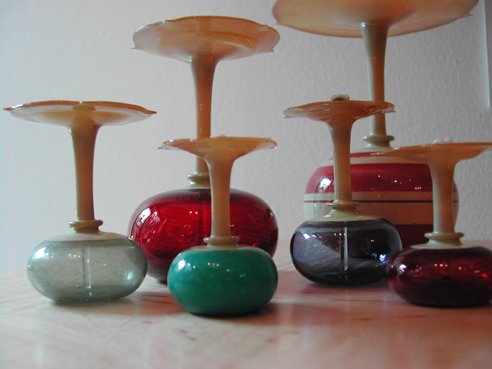
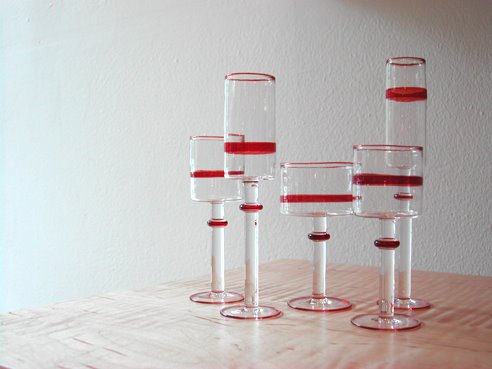
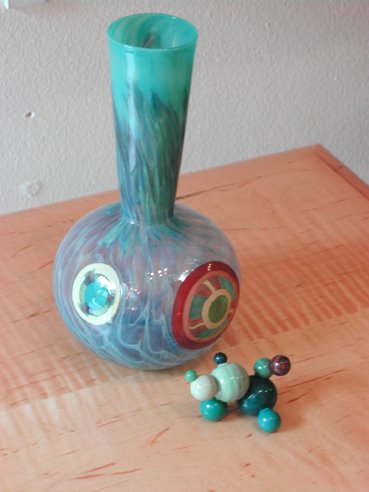
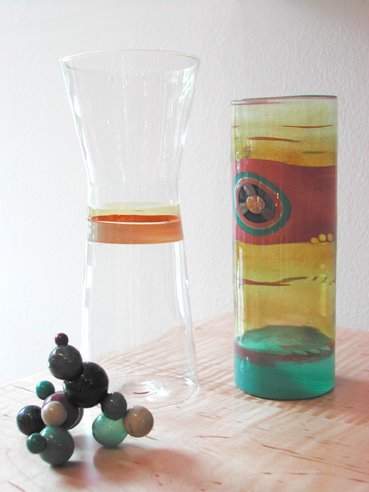
If Matt Eskuche's flameworked blown glass had a soundtrack, it would be a mix of funky '60s lounge, 1920's Parisian caberet, and Ali Farka Toure. Mysterious and precious with a distinct sense of cool, his work hints at a retro futuristic look as well as the Vienna Secession, but ultimately creates an aesthetic all its own.
Eskuche, whose professional moniker is Ess Vetro (which means "eat glass"), lives and works in Milwaukee, Wisconsin, though he travels all over the world to teach and give demonstrations. His fine, unusual work is available in NYC exclusively at Greenjeans.


Cordial glasses ($44/ea.)

Peacock montage vase ($320); Small molecule ($80)

Large molecule ($120); Saturn cup ($80); Horizon cup ($90)
(Cups are about 7" tall and make great vases)

Nymph ($150)

Perfume bottles ($32-$130)

Thursday, May 11, 2006

Organic Flowers for Mom


We hope you will come to Greenjeans to find a special gift for your Mom this Mother's Day (which is this Sunday, May 14). (Click here for some great gift ideas!)

In case you'd like to get her some nice flowers, too, pass on the mainstream competitors and consider going organic.
In raising organic flowers, growers use no toxic chemical pesticides so production is not only safer for the environment, but the flowers are also safer for farmers, for florists, and for you! Click here to read more reasons why to buy organic flowers.

If your Mom lives far away, the California-based company Organic Bouquet is offering a special on delivered arrangements for Mother's Day (pictured here). They look stunning and fresh, and if you order today and your Mom will have them in time!

If you're going to see your Mom in person, consider buying flowers for her at one of the many Green Markets around NYC or at a farmer's market in your area. Many local growers are going organic -- ask them about their growing methods.

Better yet, instead of cut flowers, consider planting her a little kitchen herb garden or window box with plants and flowers purchased at the farmer's market. That way she gets to see how much you love her all summer long!

And if you're looking for a nice vase or basket to present the blooms in, come on in to Greenjeans -- we've got you covered in that department!

Tuesday, May 09, 2006

Gift Ideas for Mother's Day

Your Mom loved it when you gave her things you'd made yourself as a kid. Nowadays, you probably don't have time to make her a pinch pot, but you can still give her something beautifully handmade with lots of heart from Greenjeans! Here are some suggestions for gifts your Mom will love:

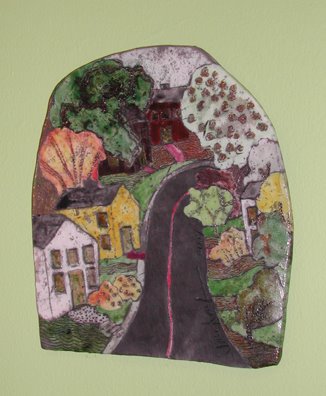
A view down the street of a New Hampshire village by Jane Kaufmann ($125)

She'll find tons of uses for these woven baskets with hardwood bottoms by Ray Lagasse ($75-$180)

Ever-popuar silver and gold jewelry by Erica Schlueter ($36-$160)

Pretty celadon porcelain tea set by Kit Cornell ($225)

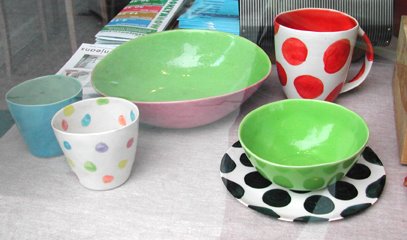
Fun porcelain juice cups, mugs, bowls, and plates by Mary Anne Davis ($16 - $66)

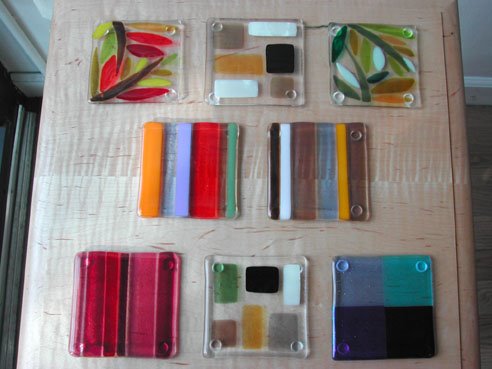
Colorful fused glass coasters by Trio Design to protect that coffee table ($25/pair)
We also have butter dishes, serving platters, and candy dishes by Trio

Carved wooden spoons by Dan Dustin that transform "slaving over a hot stove" into a more pleasant and artful experience ($45-$90)

Homey pottery vases just the right size for a desk or window sill ($15-$30)
Waterlily orb by Jane Kaufmann ($32)
Handbound book by Dennis Yuen ($36)

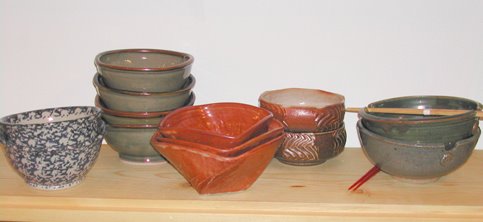
New pottery bowls for soup, salad, and cereal ($20-$40)

More lovely handcrafted jewelry by various artisans ($30 - $128)

"Super Mom" story sculpture by Jane Kaufmann (partial view, $250)
Remember, Moms love Jane's fingerpuppets, including Super Mom, Mom with Baby, and Gardener ($24/ea)

Canterbury Rocker by Brian Braskie in cherry, a very fine and special gift ($1150, 6-8 weeks lead time)

Stop in to find lots more jewelry, baskets, mugs, crockery, handbound books, and lots of other things Moms love!

We're open Tuesday-Sunday 12-7pm, or call to place an order.

And an early Happy Mother's Day to all you Moms out there from Greenjeans!

PS - This is our 100th blog posting! Woo hoo!

Technorati tags: