Showing posts with label dollar voting. Show all posts

Monday, April 06, 2009

Walmart Ad Illustrates Economies of Scale

I saw this Walmart commercial tonight for compact fluorescent light bulbs. Maybe you're already familiar with it -- apparently it's been around for a while.

I'd never seen it though, and was surprised by how perfectly it illustrates the power of dollar voting and economies of scale, which I've discussed before in this blog.


Never mind the kitschy "forest setting" and folksy acting. And hold the debate on bulb-replacement efficacy -- Walmart wants you and me to shop there, no doubt.

It’s about power in numbers. The pink-sweatered hausfrau of today cheerfully explains how not only will changing one bulb save you 40-something-dollars a year, but if all 200 million Walmart customers each changed one bulb, it would be the equivalent of taking 11 million cars off the road. And that's a good thing. (No time to elaborate on how reducing car usage is good because it means less release of CO2 into the atmosphere, etc. but oh well.)

This is a great illustration of economies of scale – the impact of one or two is small, but as the numbers grow the impact grows exponentially.

Of course, this rule applies not only to eco-friendly light bulbs but ALL the stuff they sell. And all the ways they do business, for better and for worse. The more you buy the more you’re part of their impact, positive and negative. Don’t be seduced by the Juno-esque background music.

So. Economies of scale. Dollar voting. Learn it and live it, wherever you shop.

Posted by Amy Shaw for Greenjeans.

Sunday, July 06, 2008

Consumer Culture: Peeking Underneath Campaign Tee-Shirts


There's no use hiding the fact that I'm head-over-heels for Obama. I love what he says, I love how he says it, I love dreaming about the kind of administration he'd create. I LOVED the fist bump and totally believed it was unrehearsed. I could practically be the Obama Girl!

While I've got the Obama bug, but there's one thing I don't got: an Obama tee-shirt. (Is that like being patriotic but not wearing a flag pin?)

This occurred to me the other day, when a friend mentioned seeing a tee-shirt that says "Obama Says Knock You Out" and I immediately decided I needed one. (The slogan is a pop culture reference remixed in this You Tube video.)

But then I started wondering, where's it made? What would my dollars really be going toward? Wouldn't it be better to buy directly from the campaign, cast my dollar vote where it counts?

So I did some cruising around the 'net looking to see what other kind of wearable Obama propaganda is available out there. Obama's official campaign webstore offers some nice options, stylish cuts for women, clean graphics. But nothing too fun. Their cleverest design plays off the over-imitated "got milk?" campaign, but to me the phrase "got hope?" isn't that appealing at all, even if the price is cute ($20.08).

I suggest they do one that says "got change?" instead. It would more accurately echo the campaign's ubiquitous one-word slogan, AND would also be way more funny, as in the recent headline from The Onion: "Black Guy Asks Nation for Change." Hilarious! (I do love the Obama baby onesie, though, and there are some great Obama-themed prints donated by artists. But I digress.)

Though unexciting, I was very pleased to see that the official Obama shirts are all Union Made in the USA. You'd think that would be a foregone conclusion, not worth mentioning. Wouldn't a presidential candidate naturally make sure his or her merch is American made? Well, no. I remember a story from the last election where it turned out that some branded pullovers worn by the Bush people were made in China (which is probably where all those flag pins are made too.)

Anyway, according to the small print, it appears that 100% of your tee-shirt purchase price goes to the Obama campaign, and that's a good reason to buy it too. (Thought I don't get that really. Are they donated? If I bought, say, the ladies baseball jersey, what % of the $25 sale price would actually go toward the campaign? Certainly I'd hope the workers are getting decently paid for making them, that the cotton growers and dye-makers are getting paid, and so on. So how does that work?)

Also, it unfortunately appears that the shirts are made from conventionally-grown fibers, and in fact I don't even see an organic option. I'm disappointed about this. I mean, hello??? This is important!!! C'mon guys, you're supposed to be really involved in making eco-conscious choices!!! (Organic shirts are easy to find elsewhere, though, if you google it.)

Regardless, the Obama Says Knock You Out shirt is the one I really want, and it's not on the official site. Instead I found it's sold by Urban Outfitters, which to me is a careless corporate entity that co-opts the indie spirit and parodies art, fashion, and craft in pursuit of the bottom line. It has stockholders to please, after all.

And as if that weren't enough, it may be that buying an Obama tee-shirt from Urban Outfitters is also casting a dollar vote for some unsavory business practices and political affiliations if this article, this article, and this Wikipedia entry are true. (BTW, the company owns the chain Anthropologie and the label Free People, too.)

There's no way I'm supporting the questionable sourcing of something I don't even really need. That is SO being part of the problem.

So what's a conscientious Obama-loving girl to do if she wants to show her support and remind people to vote?

I guess just straight up donate to the Obama campaign and then embroider my own damn Obama slogan on a plain tee-shirt I already have...

... or maybe I'll volunteer or get the campaign to hire me to consult them on such matters!

'Cause Obama may have my vote on Election Day, but when it comes to dollar votes I'm still undecided.

Posted by Amy Shaw for Greenjeans. Image sourced here.

Tuesday, April 22, 2008

Earth Day Tips from Greenjeans


Happy Earth Day!
Small changes and little decisions add up to big change! Here are some quick tips for achieving a smaller footprint:

1) Stop buying vinyl
I don't mean records. I mean anything containing PVC. That's the kind of soft plastic that gives off the funky smell found in everything from shower curtains to kid's toys. PVC is toxic to the environment and to your body because, among other things, it contains phthalates.

Phthalates are also found in many beauty products and baby products. Europe and California are leading the way in a ban of phthalates, even though the U.S. government insists they're harmless. Learn why here, here, here, here, and here.

2) Consider packaging
Do you really need a bag? Can you buy those nuts in bulk instead of a disposable can? Is a similar product available that's packed in less plastic? Remember when you buy something, you're not just buying the thing, you're also saying "yes" to it's packaging.

3) Use those cloth bags
And if you must take a plastic bag, reuse it as a garbage can liner. Please don't just throw it out -- plastic bags live on for hundreds of thousands of years...

4) Drink tap water
Many places, including NYC, have fantastic tap water. Don't like the taste or worried about heavy metals? Buy a water filter and fill your own dishwasher-safe reusable bottles. Buying bottled water is not only a huge drain on our wallets, it's overtaxing our highways, natural streams, and landfills (since most people don't recycle them). Plus need I remind you that water bottles are plastic, which is made from petroleum, requires a great deal of energy to produce, and lives on for hundreds of thousands of years.

5) Switch to wind or solar power
Many electric companies are offering a choice these days, and for a few cents more you can get your power from cleaner sources. Check your next electric bill -- there may be information right in there already. Or if not, give them a call. Because as more of us get involved, the prices will come down and the positive impact will increase.

The bottom line is: before you buy something, remember to ask: Do I need it? Is it worth the money and impact? And can I responsibly dispose of it? Use your dollar vote as a force for change. And spread the word!

Posted and photo (of bird in tree outside today) by Amy Shaw for Greenjeans.

Monday, July 02, 2007

"Buying Into the Green Movement" in the NY Times


The New York Times printed an article today, "Buying Into the Green Movement," about how eco-consumerism is an oxymoron perpetuated by marketers and the media leading the mainstream public to think that if they're buying something labeled "organic" it's all good. As a retail shop that promotes sustainability, I thought it would be fitting to respond.

It's a good thing that American consumers are starting to understand about the advantages of low-watt light bulbs and organic fruit. But one message that doesn't seem to be getting through is that we need to generally consume less, and we can't simply buy our way out of environmental problems.

Of course, sometimes we do have to buy things. And sometimes we simply want to buy things. And that in itself isn't necessarily bad. What I don't understand is the idea of throwing away something that's perfectly good in order to replace it with something made from "green" materials. Or of companies marketing things as "green" that require more energy to produce than their "conventional" counterparts. Baffling.

We at Greenjeans obviously don't advocate zero consumption. That's impossible anyway. But we do advocate for slower consumption, and making more mindful choices. We believe in the power of dollar voting to change the nature of consumerism entirely. And we try to offer as many items as possible produced within a 150-mile radius to keep things local.

As we state in our FAQ:

"We believe that whenever possible people should buy high-quality things that will last for generations, not seasons. The less “disposable” merchandise we buy, the smaller our ecological footprint will be. We esteem the value of the handmade and the possibility of returning to slower consumption patterns.

"Also, it is our persistent goal to operate with a double bottom line: to make a profit and to be socially and environmentally responsible. We believe that capitalism can be used in the service of changing the world, and in our own small way that is what we’re trying to do.

"More tangibly, many objects in the shop are made from recycled or repurposed materials such as old wine barrel staves used to make folding chairs, old quilts used to make stuffed toys, and old men’s shirts sewn to make the curtain at the back of the shop. The artisans who make these objects are talented craftspeople using traditional skills in an unconventional way to produce beautiful functional art.

"Remember that shopping doesn’t exist in a vacuum. Every time you make a purchase, you are also casting a dollar vote. You are voting for a product, as well as how that product is produced, transported, marketed, and sold. A dollar spent at Greenjeans is a vote for integrity, sustainability, small-scale production, and independent small business."

I'm glad the Times printed this article. It's important for us all to be reminded that living sustainably is not as easy as we're sometimes led to believe, but instead relies on each of us to be well-informed, conscientious consumers.

(Photo sourced here.)

Friday, November 24, 2006

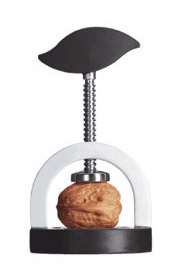
The Nut has been Cracked


Well, Thanksgiving is a wrap and I'm back in Brooklyn after nearly a week in N.H. Back just in time to crack the nut! (More on that in a minute.)

We brought back from our trip new pottery fresh from the studio by John Zentner and Jeff Brown, as well as new work by Jane Kaufmann, including several small orbs.

Small-batch, artisan-made holiday cards are also coming in, and 100% of the selling price of these goes to charity. Click here to see the fabulous batch local bookbinder Dennis Yuen just completed.

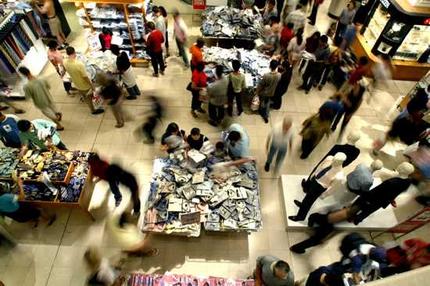
So that's my Black Friday pitch. Today is Black Friday, so named because it's the day that large retailers start turning a profit, or go "into the black," for the first time of the year. (Retailers generally make 50% of their annual intake during the last quarter of the year). That's why so many big stores open at 5am and offer lots of specials -- they're all competing viciously for the bucks on this big day.

At smaller shops like Greenjeans, Black Friday isn't as dramatic -- we didn't open at 5am, that's for sure! -- but it is special for us for another reason: today is the day that we "crack the nut."

That's the phrase Jae came up with today meaning we start in earnest to accept the fact that The Holiday Season has officially begun. And with it, the sort of holiday-flavored things it behooves a shop to do, like put up some pretty lights and decorations (we go for subtle here) and play holiday music (not so subtle).

This year on our holiday turntable we'll be spinning The Nutcracker Suite by Tchaikovsky (get it?), Duke Ellington's wonderful jazz version of that classical suite, and some good old fashioned crooners singing Christmas carols (Dino, Frank, and Nat will surely be among them!).

We're also starting our Holiday Hours, opening 7 days a week (that's right, Monday too!) 12-7pm (or later) until Christmas Day.

So! The nut has been cracked! And as you start your shopping engines, we encourage you to think local (wherever your locale) and remember that every dollar you spend is a vote. Let the wild rumpus start!

Technorati tags:


Photo sourced here.

Monday, October 23, 2006

Greenjeans Blog Highlights

Here are links to some highlights from the blog written over the past year:


Writings On "Craft"


History of Craft: Toward a New Craft World Order

How the art/craft/design debate is relevant, and a call to reclaim "craft"

History of Craft: An Initial Overview
Where it all began...

Craft & Art Crossing Over
Where knitting and sculpture meet

Two Craft Worlds
Thinking about youthful, indie-spirited craft compared with old-school craft.

Esquire Magazine Reveals the Future of Craft?!

“My father rode a camel. I drive a car. My son rides in a jet. His son will ride a camel.”

Radical(izing) Craft
Looking for the edges of craft

Review: The Renegade Craft Fair
I went, I saw, I blogged


Craft, Consumer Culture, & Ecology

Consumer Culture: Dollar Voting
The politics of shopping

Consumer Culture: Mass-Produced Indiviudality
A call to return to small-scale production

Consumer Culture: Branding Peace
Is there a place for peace in consumer culture?

What Does "Green" Mean?
Is living "green" possible?

Buy Quality, Help the Planet
How craft relates to sustainability


Some Favorite Posts

Pretty


New Arrivals from Davistudio / Toward a Phenomenology of the Handmade

Trip to NH & VT: Wedding, Bread & Puppet, & Taxidermy

The Craft of Mummification

At Last, the Display Cases!


Does Living Amongst Beautiful Things Promote Longevity?

Inspiring Treetop Spheres

Thursday, April 20, 2006

Buy Quality, Help the Planet


"Buy quality products that will last longer. Over time, you'll obviously buy fewer products that way."

That's one of the tips for helping to combat climate change offered by the Earth Day Network. And Greenjeans is a great place to buy quality products, all of which are handmade in very small quantities by thoughtful artisans.

From sturdy wooden toys made from untreated Maine pine and soft cotton toys made from recycled quilts to high quality furniture built to last for generations and studio-made tableware that'll beat your big box blues, Greenjeans is filled with beautiful works of art-you-can-use that are made to last.

Buying quality doesn't mean you have to spend a fortune (although you can if you like!). The wooden toys start at $7, little stuffed animals made from recycled blankets are $15, and handmade pottery (mugs, plates, bowls) start at $16. The Shaker furniture is definitely pricier, but it is also in museum collections, so the fact that it can be had at all is the bargain. In a few weeks, however, we will be offering wonderful chairs made from reclaimed wine barrel staves for $160, a price even Ikea would love.

In honor of Earth Day (which is this Saturday April 22), we will be showcasing as many green colored items we can find in the shop, so come by and take a look! (I'll post a picture on the blog, too.)

Meanwhile, click here to take a quiz to measure your impact on the earth's resources. It's a little vague, but it did help me to see areas of my life where I could do better.

And no matter what anyone else says to discredit our efforts,
every little bit DOES count!

Wednesday, February 15, 2006

Consumer Culture: Branding Peace


In this week's New York Magazine, Jada Yuan reports about Deepak Chopra's recent efforts to turn peace into a consumer trend, making peace as marketable as war ("How to Reposition a Brand Called 'Peace'"). Toward this end, Chopra and others have established a non-profit called Alliance for a New Humanity and hired Jeff Dunn, a major brand developer, to "reposition" peace as a brand.

"Real peace isn't antiwar demonstrations," says Chopra. "It's taking care of the environment, helping the poor achieve economic parity, making sure human rights are protected, and finding nonviolent means of conflict resolution." He is considering an inverted peace sign as the logo. "Think of it as the Green Housekeeping seal of approval," writes Yuan.
From our point of view at Greenjeans, this trend has been brewing for a while. We ourselves are what Dunn calls "conscious consumers," those who represent 3-4% of consumers worldwide "who, given a choice between two similar products, choose the one made by a company with better social and environmental policies." (See my post "Consumer Culture: Dollar Voting.") And through Greenjeans we are trying to spread this philosophy. Hence our tagline, "Handmade for Conscientious Living."

We believe firmly that there is space for peace in consumer culture. That there can be integrity and consideration underlying business practices. And that we can all live with beautiful things and make a living while helping to make the world a better place. That is our motivation, and I think that's what Chopra has in mind, too. The movement is afoot...

Thursday, December 15, 2005

Consumer Culture: Dollar Voting

The holiday shopping season is in full swing, and this year, in the spirit of conscientious living, we at Greenjeans ask you to consider the notion of the “dollar vote” as you shop for the people on your gift list.

The dollar vote is a concept economists use to describe how, in a market economy, consumers effectively vote for products—as well as how those products are produced, transported, marketed and sold—by spending their dollars. Through our “consumer sovereignty” we have the power to make our preferences known, one dollar vote at a time.

Founded on the social and aesthetic ideals upheld by the Shakers and the Arts and Crafts movement, Greenjeans promotes the values of craftsmanship, sustainability, and conscientious living by providing a source to find thoughtful, beautifully made objects for the home and children. From classic wooden toys and inviting pottery to fine porcelain dinnerware and handsome furniture, Greenjeans offers an exclusive selection of items made one-at-a-time by independent artisans, bringing traditions of fine handcraft to the urban market.

With an eye toward slowing the corporate-driven consumption cycle that exploits the global labor force and plants “big-box” stores in old cornfields, Greenjeans facilitates connections between people who care to own quality, handmade things and the skilled artisans who make them.

A dollar spent at Greenjeans is a vote for integrity, sustainability, and small-scale production. We invite you to shop with us this holiday season, and we wish you peace and joy.

A portion of proceeds from our holiday season sales will be donated to local charities.

(Thanks to Brooklyn's develop-don't-destroy blog No Land Grab for picking up this article!)

(Photo: Ben Rushton)